

In preparation for the Work Programme for 2027, Chips JU is organising an online consultation workshop on the 5th of October 2026. The proposed topic intends to address sustainable semiconductor manufacturing, with different actions.
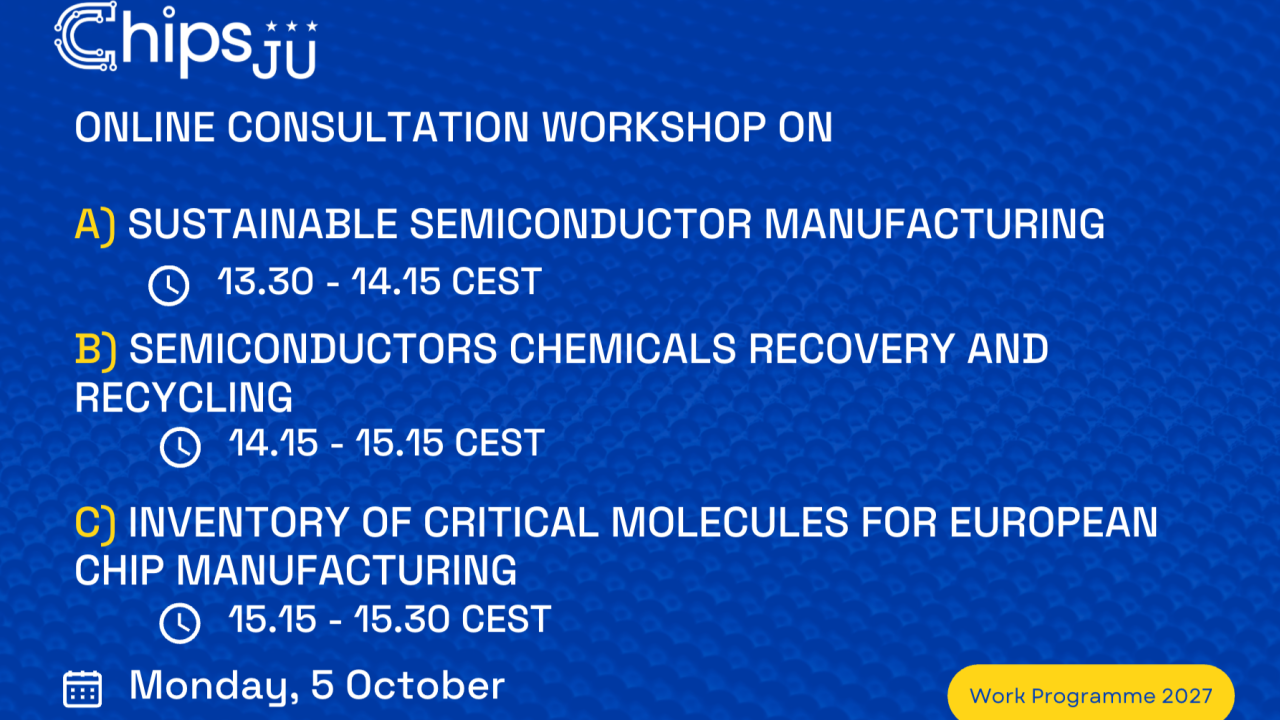
📅 5 October 2026
🕙 13:30 – 15:30 CEST
💻 Online
Topic: Sustainable Semiconductor Manufacturing
Chip production is highly resource-intensive, requiring large amounts of energy, ultra-pure water, chemicals, gases, and raw materials. As demand for semiconductors grows, improving sustainability helps reduce environmental impact, lower greenhouse gas emissions, strengthen supply security, cut operating costs, and increase resilience against water, energy, and material shortages. It is also increasingly important for compliance with environmental regulations and for supporting Europe’s industrial and climate goals.
The workshop will explore the needs on different areas such as: advance semiconductor sustainability at TRL 5–7 by moving from research to pilot validation and industrial deployment; strengthen circularity by recovering critical materials, promoting wafer and equipment reuse, and designing-for -recyclability for tools and packaging; also evaluate the progress over state-of-the-art and current activities for abatement and process adaptation and follow-up. Finaly study the need for improve of fab resource efficiency through energy optimisation, waste heat recovery, ultra-pure water recycling, and wastewater valorisation.
Topic: Semiconductors chemicals recovery and recycling
Chip manufacturing depends on high-purity chemicals and gases that are costly, energy-intensive to produce, and often sourced through fragile global supply chains. Recovering and reusing these substances can reduce waste, lower raw material demand, cut emissions, improve supply security, and decrease operating costs. Semiconductor chemicals recovery and recycling in fabs is important because it supports circularity, reduce hazardous waste, and improve resilience against shortages of critical industrial inputs. But specially for PFAS-related substances because they are persistent in the environment, increasingly regulated, and widely used in semiconductor processes.
In this topic, it is expected to, including a LCA database and an environmental impact calculation, develop technologies to recover and recycle critical semiconductor gases and chemicals from fab waste and exhaust streams; Enabling not only circularity but also alternative developments for fluorinated gases, PFAS-related fluids but also other solvents, process gases, and other materials through high-purity recovery and treatment. All this, looking for supporting supply security, regulatory compliance, and in-fab reuse through robust purity verification, analytics, and monitoring systems.
Topic: Inventory of critical molecules for European chip manufacturing
An inventory of critical molecules for European chip manufacturing is important because it may establish a comprehensive, continuously updatable evidence base on critical molecules and materials for European semiconductor manufacturing, to underpin policy, investment, and industrial decisions under Chips Act 2.0. It can identify supply-chain vulnerabilities, import dependencies, purity requirements, production gaps, and strategic risks, while also supporting diversification, resilience, and future capacity planning under European industrial policy.
The objective in the workshop will be to study the convenience and best approach for the topic of building a comprehensive inventory of critical molecules used across semiconductor manufacturing and to map their sources, purity requirements, and supply dependencies. It also aims to assess European production feasibility, identify diversification options, develop strategic risk scoring, and forecast future demand shifts linked to scaling, advanced packaging, and new materials.
For the three topics, experts from the field will introduce the needs and identify directions to develop the different topics mentioned and where collaborative research can produce significant impact for the European semiconductors ecosystem.
 Register here for the workshop